
How sector definitions work
Infometrics defines sectors using a hybrid industry‑and‑occupation method that deliberately goes beyond standard industry classifications. This approach is designed so that sector definition captures workers based on what people do, not just where they work. A more accurate definition of a sector leads to better measurement and monitoring of every sector.
The core principle
Infometrics defines a sector as the union of:
- Relevant industries and
- Relevant occupations, regardless of industry
This means a worker can be included in a sector either because:
- they work in an industry that is central to the sector, or
- they work in an occupation strongly related to the sector, even if their employer is in a different industry.
Why do we do this?
Standard industry‑only definitions (for example Australian New Zealand Standard Industry Classification - ANZSIC - industries alone) miss a large share of cross-industry occupations. For example:
- ICT professionals in government
- Accountants in manufacturing companies
Infometrics’ method corrects this by focusing on functional capability, not just firm type.
How the method works step‑by‑step
Industry component
Infometrics first identifies industries strongly associated with the sector, using:
- ANZSIC industry codes
Using the Accountancy Sector as an example, we would include the following industries:
- Accounting Services (ANZSIC code M693200)
Anyone working in this industry is included in the sector automatically.
Occupation component
Next, Infometrics identifies sector‑defining occupations, using:
- ANZSCO occupation codes
- Role‑based skill definitions
These occupations are included regardless of the industry they sit in.
For the Accountancy Sector example, we would include all:
- Accountants (code 221111)
- Management Accountants (code 221112)
- Taxation Accountants (221113)
So, an accountant in a construction firm or an auditor in a local council are both counted as part of the Accountancy sector, even though their employers are not accounting firms.
Excluding industries or occupations
If your sector explicitly excludes certain industries or occupations, it is possible to exclude them from the definition. For example, the accountancy sector which we have defined above might explicitly exclude the government sector.
We can therefore exclude all workers in the three specified occupations who are employed in:
- Central Government Administration (O751000)
De‑duplication
Infometrics ensures people are only counted once, even if they meet both criteria (e.g. an accountant working in an accounting firm). This avoids double‑counting.
Using a hypothetical example
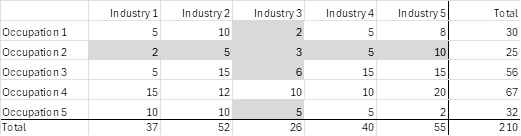
We can use a hypothetical example in an economy which has five industries and five occupations with total employment of 210 workers.
Included in our hypothetical sector are all employees in Industry 3 and all employees in Occupation 2. We have excluded all employees in Occupation 4.
The shaded cells in Figure 1 show which workers are included in our sector. There are 16 employees from Industry 3 (26 less 10) and an additional 22 employees in Occupation 2 (not counting the 3 which are employed in both Industry 3 and Occupation 2 which have been counted as part of Industry 3) giving total employment in the sector of 38.
Figure 1.
Complete flexibility
Infometrics has even more flexibility in defining sectors than described above.
For example, we can include only portions of an industry. You might wish to define:
- a tourism sector and only include the portion of each industry which is related to tourism, or
- define a Māori sector and only include the Māori proportion of each industry.
If you need a complex sector defined contact an Infometrics economist and we could help you.